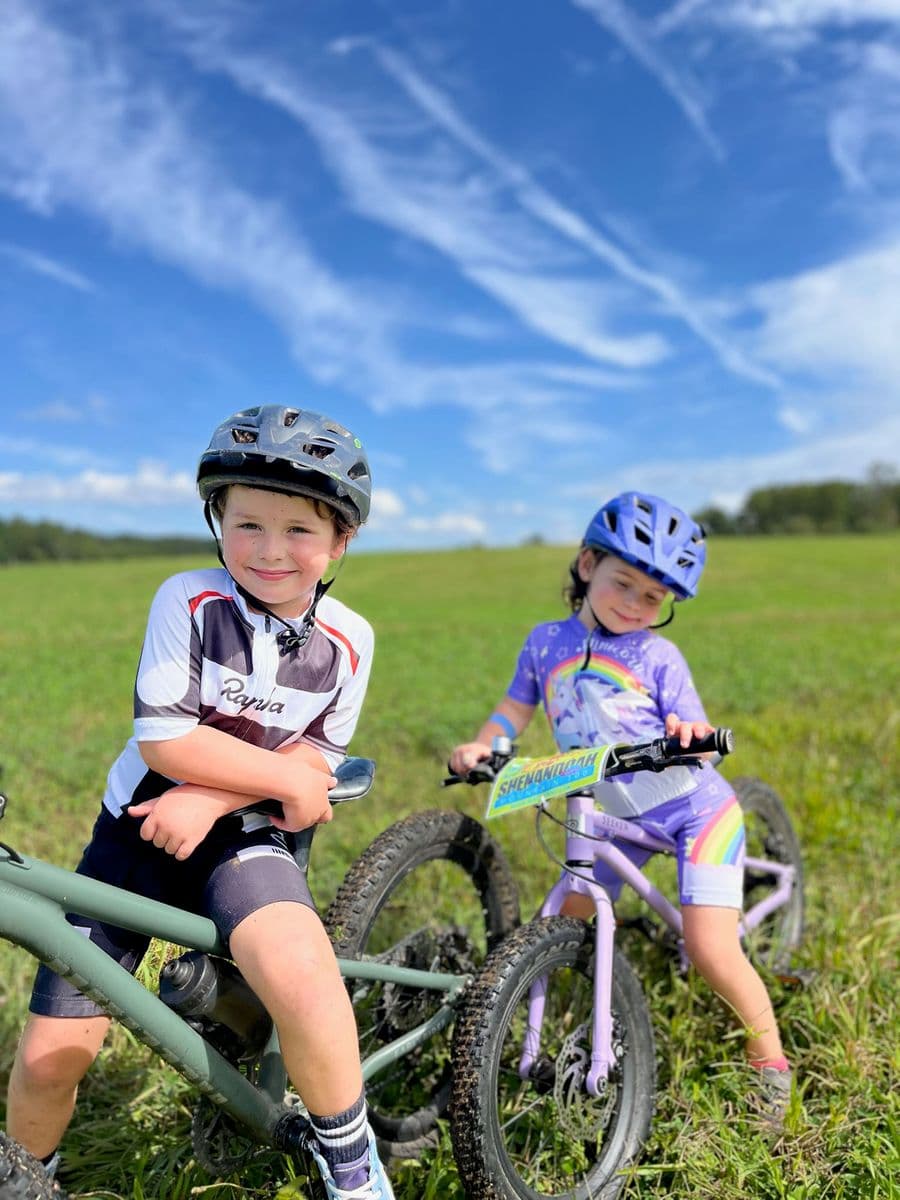
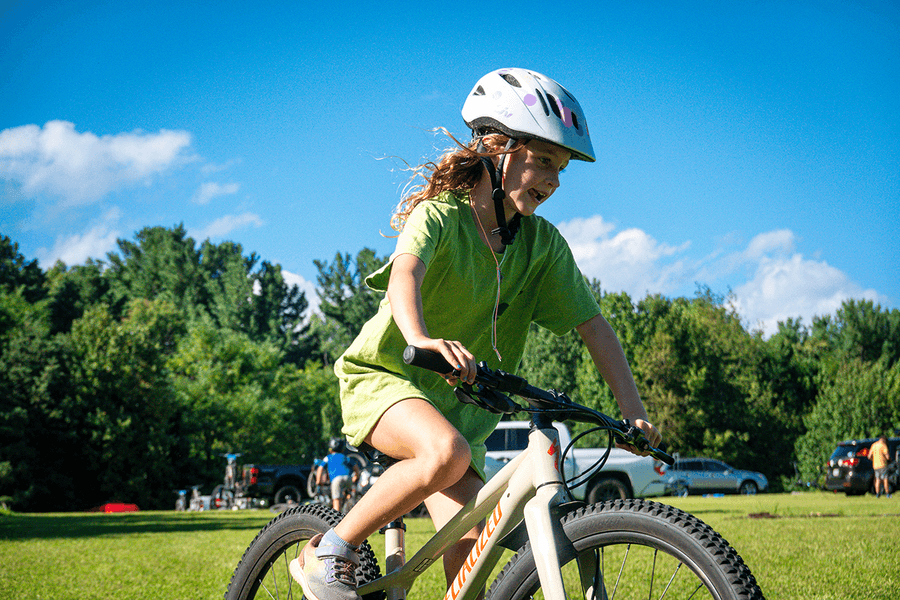
I'm an Olympic cyclist and professional gear editor, I’ve spent my life analyzing the relationship between an athlete and their equipment—but I didn't see the same barriers when it came to my own daughter’s first bike.
- It Might Be the Bike: If your child wants to ride but keeps struggling, they may not be the problem. A bike that is too heavy, too big, or too hard to pedal can make a ready kid look unready.
- Make Pedaling Easy: Small kids do not need a bike built for speed. They need one they can get moving from a stop, pedal across grass, and keep rolling over small hills without grinding to a halt.
- Buy the Size They Need Now: It is tempting to buy a bike with room to grow, but a bike that's too big is harder to control. The right fit today helps kids build confidence faster.
My daughter did not seem ready for a pedal bike.
At least that’s what I thought at first.
She could ride her balance bike, but desperately wanted to pedal. She had watched her older brother rip around our yard enough times to know exactly what she was missing. But every time we put her on her bike, at her insistence, the same thing happened: a push, a few pedal strokes, then she’d grind to a halt amid grunts and tears of frustration.
All she wanted to do was pedal, and the basic skills were there, as long as she was headed slightly downhill. She just couldn’t push the pedals hard enough.
The bike was technically the right size, and every bit a real kids’ bike. But it was too much bike in precisely the wrong way: the gearing was too hard. She could ride it downhill, but the moment she lost momentum the ride ended.
And that was the beginning of the hard lesson we learned: A kid struggling to ride does not always mean they’re not ready. Sometimes it’s the bike, not the rider, that’s getting in the way of progress.
We swapped her onto the Prevelo Zulu One, and the change was immediate. The same kid who previously couldn't pedal was suddenly riding around our yard on her own. It wasn’t perfect or without the occasional wobble, but she had enough control and confidence that riding finally became fun.

The ultra-low gear of the Zulu One was the key that unlocked the secret of riding.
The Bike That Changed It for Her
The Prevelo Zulu One is a 14-inch kids mountain bike built for small riders who are ready to pedal but still need the right bike to make the job easier. As adults, we take it for granted that we know to push harder on the pedals when going uphill. Little kids just learning to ride can’t do that.
We didn’t consider gearing when we bought our daughter’s first pedal bike. A lot of small kids’ bikes look like fantastic bikes to learn on, but they can be heavy, over-geared, and fitted with parts that technically function well but are hard for small hands and short legs to use.
The Zulu One, like our other favorite first pedal bikes, is different. It is light for its size, stable enough to accommodate riders who are new to steering a bike, geared low enough for little legs with developing muscles, and outfitted with parts that make sense for the smallest riders. It is also expensive. That part is hard to ignore. But after watching my daughter go from tears to riding independently, I stopped thinking about it as a fancy kids’ bike and started thinking about it as the bike that removed the barriers.
Weight Matters More for Kids Than Adults
A 14-pound bike sounds light until you remember how small the rider is. For a 40-pound child, that bike is 35 percent of their body weight, equivalent to a 175-pound adult riding a bike that weighs more than 60 pounds.
A heavy bike makes everything harder. Turning, especially at low speed, requires more balance, it’s harder to get going and harder to stop without tipping over, and it’s more difficult to pick the bike up off the ground after a fall. And they’ll fall a lot.
Low Gearing Makes Riding Possible
Adults can muscle up a hill in a big gear. Small kids cannot.
The Zulu One uses an 18-tooth front ring with a 10-tooth cog in back, which gives it lower gearing than many comparable 14-inch bikes. That may sound like an obscure detail, but it changed my daughter’s riding. On her previous bike, she could barely get moving anywhere except flat-to-slightly-downhill pavement. On the Zulu One, she could ride around our uneven backyard without stalling every few pedal strokes.
Stable Geometry Builds Confidence
Tiny bikes can feel twitchy if not designed properly. That is a problem that’s exacerbated when the rider is also tiny, inexperienced, and still figuring out how steering, balance, braking, and pedaling all work together. You don’t want an aggressively designed bike with precision handling that responds to a light touch–you need a bike that can absorb the shaky steering of an unsteady rider and still help them maintain a semblance of a straight line.
The Zulu One uses more modern geometry than many small kids’ bikes. In fact, some of the design elements, like the low center of gravity, longer wheelbase, and slack head angle are concepts borrowed from modern adult mountain bikes. The longer wheelbase and slacker head angle help it feel more stable under a new rider, and give a child room to make small mistakes without everything going sideways.
For new riders, stability equals confidence.

Armed with her Zulu One, and a Tow-Whee bungee strap for backup, we were able to tackle rail trail adventures that were previously off-limits.
Brakes Small Hands Can Actually Use
I used to think hydraulic disc brakes on a 14-inch kids’ bike were overkill. Then I realized easy, consistent brakes give early riders more control when they make mistakes, like carrying too much speed into a turn or down a small hill.
Hydraulic disc brakes add a little weight compared with simpler and cheaper rim brakes, but they are easier for small hands to operate because they require less effort to pull the brake lever. That matters when a kid is tired, scared, distracted, or simply going too fast.
The first time you see a runaway child come skidding safely to a stop before things go wrong, you understand why good brakes matter on small bikes too.
Short Cranks Help Kids Pedal Naturally
Crank length is another one of those details many parents never think about until they watch a small kid struggle to pedal smoothly.
Prevelo uses custom short cranks on the Zulu One, paired with a narrow stance and small pedals. That keeps the pedaling motion more natural for little legs and helps reduce pedal strikes in turns or on uneven ground.
I learned this the hard way with my son. I once put adult-sized pedals on one of his early bikes because I thought the larger platform would help him keep his feet on the pedals better. It worked in one sense, but it also caused frequent pedal strikes when he turned or rode uneven terrain. Small bikes need small-bike parts, not just scaled-down frames outfitted with leftover adult components pulled from the parts bin.

An offset seat tube lets you drop the saddle all the way down, which is helpful when using it as a balance bike.
A Balance Bike Bridge Helps
Kids do not all move from balance bike to pedal bike on the same timeline. And often the move isn’t linear.
My son stayed on a balance bike until he was four, then jumped straight to a larger pedal bike. My daughter outgrew her balance bike earlier, before she was fully ready to pedal everywhere on a standard 14-inch bike.
The Zulu One can help bridge that gap because it can be set up as a balance bike with Prevelo’s conversion kit. That lets a child get comfortable with the frame, tires, brakes, and position before adding the complication of pedaling.
That feature will not matter for every kid. But for kids caught between “too big for a tiny balance bike” and “not quite ready to pedal everywhere,” it can be the difference between forcing the jump and letting them make the transition on their terms.
What to Look for in Your Child’s First Pedal Bike
The Prevelo Zulu One worked for my daughter, but the bigger lesson is not that every kid needs this exact bike. The lesson is that attention to the right details can be the difference between your child taking off under their own power or walking away in frustration.
Before buying your child’s first pedal bike, look beyond wheel size and color. Those are the obvious parts. The details that matter most are the ones that determine whether your kid can start, steer, stop, and keep riding without fighting the bike.
How to Choose the Right Kids Bike
Best First Pedal Bikes for Kids
These are the first pedal bikes I’d look at first, depending on where your kid rides and how much transition help they need.

Prevelo
Zulu OneWhat We Love
- • Lightweight relative to most kids’ bikes
- • Stable, confidence-building geometry
- • Converts between balance and pedal bike
- • Hydraulic disc brakes
Worth Knowing
- • Expensive for a 14-inch bike
- • Still heavy relative to a small child’s body weight
- • Best value if passed down or resold
The Zulu One is the bike that changed riding for my daughter. It is light, stable, geared low, and built with kid-specific parts that make a real difference for small riders. It is expensive, but it is one of the best examples of what a first pedal bike can be when every detail is designed around a small rider.
Best for: kids ready for a capable 14-inch pedal bike, especially if they will do a lot of riding off-pavement.

Woom
Go 2What We Love
- • Low gearing
- • Stable geometry helps new riders feel more in control
- • Steering limiter helps prevent over-rotating the handlebars
- • Color-coded rear brake lever makes coaching easier
- • Woom trade-in program helps offset the next size up
Worth Knowing
- • Premium price for a first pedal bike
- • Ships with a coaster brake and hand brakes
- • Freewheel kit is sold separately and worth considering ($26)
Woom has earned its reputation for making very light, approachable kids’ bikes. The Woom 2 is a strong pick for kids who are learning mostly on pavement, sidewalks, driveways, and smooth paths. It does not have the same trail-ready build as the Zulu One, but its low weight and kid-friendly fit make it one of the easiest bikes for many kids to start on. I also like the color-coded brake levers that make it easier to teach kids the difference between the front and rear brakes.
Best for: pavement, neighborhood riding, and parents who want the lightest, simplest learning experience.
.png%3F2026-04-22T16%253A29%253A45.165Z&w=3840&q=100)
Prevelo
Alpha TwoWhat We Love
- • Extremely low gearing that makes starts and climbs easier
- • One of the lightest bikes in the 16" category
- • Balance-Tec system allows true balance bike conversion
- • Versatile tires for pavement and light dirt use
- • Stable, upright fit that works well for most kids
Worth Knowing
- • Very similar in fit and ride to the Woom 3
- • Balance bike conversion requires removing parts
- • Not built for aggressive riding or rough trails
- • Rim brakes are appropriate for this stage, but not for higher-speed riding
The Prevelo Alpha Two is a premium 16-inch bike that rides very similarly to the Woom 3, with closely matched weight, gearing, fit, and handling. The difference is Prevelo’s Balance-Tec design: you can remove the cranks and chain to run it as a true balance bike, then convert it back to pedals when your child is ready. It's one of a very few number of 16-inch bikes with that feature. It is light, geared low for easy starts, and has an upright, stable fit.
Best for: kids who will ride mostly on paved or smooth surfaces, and bigger riders who are still learning the mechanics of pedaling.

Early Rider
Belter 16 AutoWhat We Love
- • Automatic 2-speed hub
- • Belt drive is clean and low-maintenance
- • Premium build quality and strong resale value
Worth Knowing
- • V-brakes require more maintenance than disc brakes
- • Not the best choice for off-road riding
- • More expensive than many basic 16-inch bikes
The Early Rider Belter 16 Auto is a unique 16-inch bike for kids who ride pavement, paths, gravel, and packed dirt. Its standout feature is a 2-speed automatic rear hub that gives young riders easier starts and more speed once they’re rolling, without making them think about shifting. The belt drive is quiet, clean, and low-maintenance, which parents will appreciate every time the bike goes in the car. Wide tires and stable geometry help it feel confident on mixed surfaces. It’s not a true trail bike, but for everyday riding with some dirt mixed in, it’s excellent.
Best for: kids who ride pavement, gravel paths, cinder trails, packed dirt, and rolling neighborhoods where a single-speed can feel limiting.
Looking for more than just their first bike? Explore our full collection of expert-vetted gear, helmets, and sizing advice in All Kids Bikes & Gear.
The Kitli Promise
We earn commissions through affiliate links. That’s how we fund our testing and keep Kitli free. But commissions never influence what we recommend.
“If we wouldn't use it with our own families, we don't recommend it to yours.”
Read Our Story →Bobby Lea
Co–Founder
Bobby Lea is a dad of two and co-founder of Kitli. Before launching Kitli, he was a senior reviews editor at Bicycling, where he spent years testing gear and helping readers decide what was worth their money. He also raced bikes professionally for more than a decade and competed in three Olympic Games. He lives with his wife and kids on a farm in rural Pennsylvania, where his children are very good at finding the limits of whatever gear they use.
View Profile →